
Quick Answer
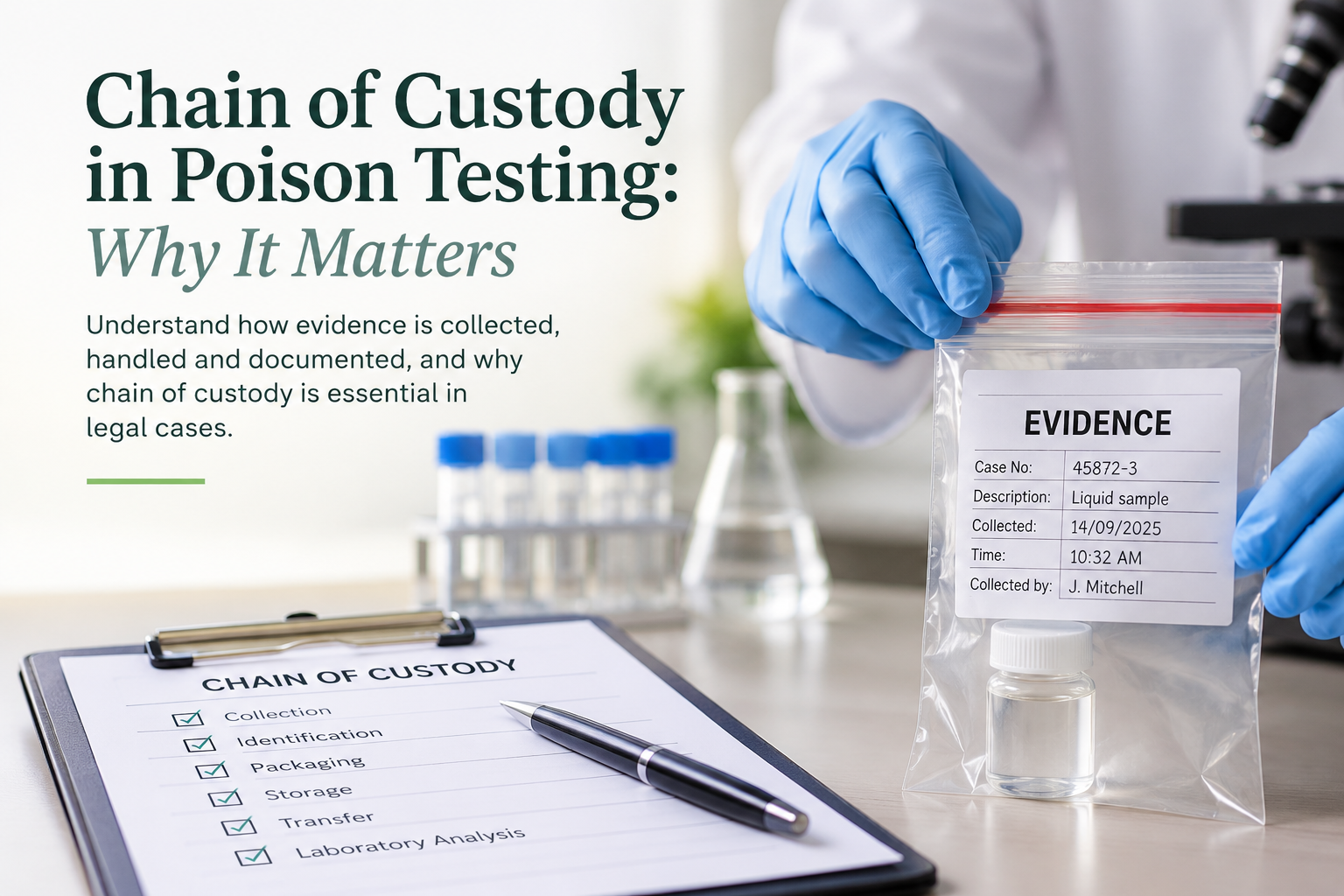
Chain of custody in poison testing is the documented record of how a sample is collected, identified, transferred, stored and analysed. It helps establish that the evidence tested by a forensic laboratory is the same material associated with the investigation. Accurate records, secure packaging and documented transfers can strengthen confidence in toxicology findings and help legal professionals assess whether the evidence is reliable. However, chain of custody alone does not prove poisoning, establish intent or determine the cause of an injury or death.
Introduction
When suspected poisoning becomes part of a legal investigation, laboratory results may help answer important questions about a person’s exposure to a potentially harmful substance. However, identifying a toxin is only one part of the process. Investigators and legal professionals must also understand where the sample came from, how it was handled and whether its history can be reliably documented.
This is where chain of custody becomes essential. From the initial collection of a suspected substance to the preparation of a forensic report, every relevant stage should be recorded appropriately. Missing information, inconsistent labelling or unexplained transfers can create questions about the identity and integrity of the evidence.
Understanding these procedures helps attorneys, investigators and individuals involved in suspected poisoning cases make better-informed decisions about laboratory testing and the interpretation of results.
What Is Chain of Custody in Poison Testing?
Chain of custody is a chronological record documenting the possession, handling, transfer and storage of evidence throughout an investigation. In poison testing, it may apply to biological specimens, suspected chemicals, food, beverages, medicines or other materials submitted for laboratory analysis.
Depending on the case, the record may include:
- The sample’s unique identification and description.
- The date, time and location of collection.
- The identity of the person collecting the evidence.
- Details of each transfer between authorised individuals.
- Relevant packaging, storage and handling information.
- Laboratory receipt, sample condition and associated documentation.
These records help establish a traceable history of the material being examined. The exact requirements depend on the specimen, laboratory procedures and intended legal use.
For cases requiring formal documentation, The Carlson Company provides a Chain of Custody Form and guidance on evidence submission.
Why Is Chain of Custody Important in Legal Poisoning Cases?
1. It Helps Establish Evidence Identity
A toxicology report is meaningful only when the sample analysed can be connected to the relevant person, substance or incident. Clear identification and consistent records help reduce the risk of confusion between samples.
For example, if two specimens are collected during the same investigation, each should have its own appropriate identifier. If their labels or accompanying records conflict, questions may arise about which sample was actually analysed.
A documented chain of custody helps legal professionals trace the evidence from collection through laboratory examination.
2. It Helps Protect Sample Integrity
Evidence can be affected by contamination, leakage, unsuitable storage or other handling problems. Proper packaging and documented procedures help minimise these risks and identify issues that may need further assessment.
The appropriate handling requirements vary according to the material. A biological specimen may require different storage conditions from a suspected chemical, food sample or unknown liquid.
If poisoning is suspected, the collection and preservation process should follow appropriate professional guidance. Potentially hazardous materials should not be handled or shipped without suitable instructions.
3. It Supports the Evaluation of Laboratory Findings
A laboratory may use specialised analytical methods to identify substances in a submitted sample. However, the result must be interpreted alongside the specimen’s identity, condition, collection history and the question being investigated.
A complete chain-of-custody record helps reviewers understand the sample’s documented history. It does not independently establish that a detected substance caused symptoms, contributed to a death or was deliberately administered.
For more information about analytical methods, see The Carlson Company’s GC-MS testing and analysis services.
4. It Helps Legal Professionals Assess Evidence
In a dispute or criminal investigation, lawyers may need to examine how evidence was obtained and whether its handling can be explained. Chain-of-custody documentation provides a record that can be reviewed alongside laboratory reports, witness statements and other case materials.
An unexplained gap may lead to questions about authenticity or reliability. However, a documentation issue does not automatically make evidence inadmissible. Its significance depends on the circumstances, applicable legal rules and whether other evidence can establish the sample’s identity and integrity.
What Happens If the Chain of Custody Is Broken?
A broken or incomplete chain of custody means that some part of the evidence history cannot be adequately documented or contains an inconsistency requiring investigation.
Potential problems include missing signatures, incorrect sample identifiers, undocumented transfers, damaged seals or gaps in storage records. The consequences depend on the nature and seriousness of the problem.
Consider a suspected poisoning case in which a liquid sample is collected and sent for analysis. If the container arrives with a damaged seal and no explanation of when the damage occurred, a reviewer may question whether the sample remained protected during transport.
The appropriate response is to document the issue, preserve relevant records and assess its potential effect on the evidence. Where necessary, legal counsel or a qualified forensic professional can determine whether additional testing, clarification or independent review is appropriate.
For a more detailed discussion, read about chain-of-custody errors in forensic evidence.
How Is Chain of Custody Maintained During Poison Testing?
Maintaining an effective chain of custody involves coordinated procedures before, during and after laboratory analysis.
Collection and identification: The person collecting the material records the required case and sample details. Each specimen should be clearly identified using the applicable procedure.
Packaging and sealing: Suitable containers and packaging help protect the material against leakage, contamination or damage. Any required seals should be applied and documented according to the relevant protocol.
Documented transfer: Each custody transfer should be recorded as required, including the relevant people, dates, times and acknowledgements. Records should be completed promptly rather than reconstructed from memory later.
Secure transport and receipt: The sample should be transported and received according to applicable handling requirements. The receiving laboratory can document its condition and identify discrepancies that require attention.
Laboratory analysis and reporting: The laboratory records relevant information about the specimen, analytical process and findings. Chain-of-custody records form part of the wider documentation used to evaluate the evidence.
The precise procedure varies by case. Anyone preparing a sample for formal testing should confirm the laboratory’s requirements before collection or shipment.
How Does Chain of Custody Work With Forensic Toxicology?
Forensic toxicology examines the presence and potential significance of drugs, poisons, chemicals and other substances in biological or non-biological samples. Chain of custody documents the evidence history; toxicological analysis investigates the material itself.
Both are important, but they answer different questions.
For example, a test may identify a substance in a biological specimen. The analytical finding can indicate that the substance was detected under the conditions of the test. Establishing when exposure occurred, whether the concentration was harmful and whether it contributed to an outcome may require additional scientific and case-specific evidence.
The appropriate sample and analytical method depend on the suspected substance, timing and circumstances. The Carlson Company’s forensic toxicology testing services support investigations in which laboratory findings may be relevant to legal matters.
Where the identity of a submitted material is uncertain, unknown substance analysis may also be relevant.
What Should Attorneys Check Before Commissioning Poison Testing?
Before submitting evidence, attorneys and investigators should clarify the purpose of the analysis and the documentation needed for the case.
Important questions include:
- What material needs to be tested, and is enough sample available?
- Which analytical method is appropriate for the suspected substance?
- What collection, packaging and chain-of-custody documentation is required?
- How should the sample be stored and transported?
- What will the report establish, and what limitations should be considered?
- May the findings require expert interpretation or testimony?
These questions can help align the testing process with the legal issue being investigated. They may also identify practical concerns before evidence is submitted.
Frequently Asked Questions
1. Why Is Chain of Custody Important in Poison Testing?
Chain of custody documents how evidence was collected, handled, transferred and stored. It helps establish the identity and integrity of a sample and allows legal professionals to review its history when assessing toxicology findings.
2. What Information Should a Chain of Custody Form Include?
Depending on the applicable procedure, it may include sample identification, collection details, the names of responsible individuals, transfer dates and times, acknowledgements, and relevant handling or storage information. Follow the requirements provided by the laboratory and relevant authorities.
3. Can Poison Test Results Be Challenged If Chain of Custody Is Incomplete?
Yes. Missing or inconsistent documentation may raise questions about the sample’s identity or integrity. However, the effect on the evidence depends on the circumstances and applicable legal rules; an incomplete record does not automatically make the results inadmissible.
4. Does Chain of Custody Prove That Someone Was Poisoned?
No. Chain of custody documents how evidence was handled. Laboratory analysis may identify a substance, but determining whether poisoning occurred requires interpretation of the findings alongside relevant medical, investigative and other evidence.
5. Who Is Responsible for Maintaining Chain of Custody?
Responsibility depends on the case and applicable procedures. Collectors, investigators, transport personnel and laboratory staff may each have documentation responsibilities during the stages in which they handle the evidence.
Conclusion
Chain of custody is a fundamental part of poison testing when laboratory findings may be used in a legal investigation. Accurate identification, appropriate handling, secure packaging and documented transfers help establish a traceable evidence history. Combined with suitable analytical methods and careful interpretation, these procedures support a more thorough assessment of forensic toxicology findings.
If you need poison testing, laboratory guidance or forensic support for a legal matter,
Call toll-free: +1 866-889-3410
You can also visit our Contact Us page to speak with our team about your testing requirements.
