
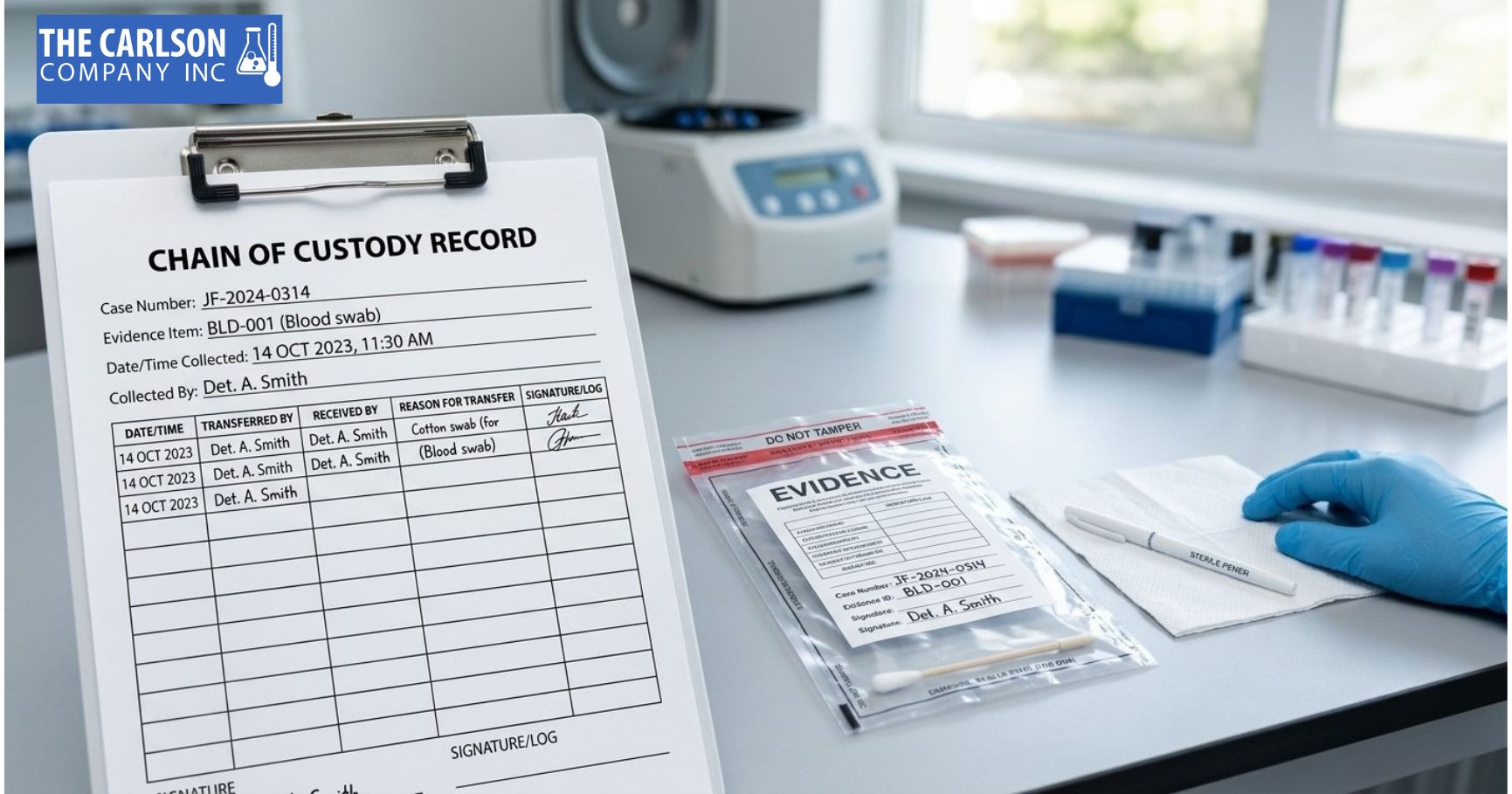
Forensic evidence can be highly valuable in an investigation, but its value depends not only on what a laboratory finds. There must also be a reliable record showing how the evidence was handled from collection through storage, transfer, examination, and final disposition.
Chain of custody errors can create uncertainty about who handled an item, when it was transferred, where it was stored, or whether it remained properly identified and protected. Even when the underlying evidence has not been intentionally altered, gaps or inconsistencies in its handling history can raise questions about its integrity and reliability.
Understanding the most common failure points can help investigators, evidence personnel, legal professionals, and others involved in forensic testing reduce avoidable problems.
What Does It Mean to Compromise the Chain of Custody?
A chain of custody is intended to provide a chronological record of an evidence item’s movement and handling. It should allow someone reviewing the case to understand who had custody of the evidence, when custody changed, where it was stored or transferred, and why the transfer occurred.
A problem may arise when that record is incomplete, inconsistent, or cannot be reconciled with the physical evidence.
It is also important to distinguish a chain-of-custody problem from an evidence-integrity problem. A custody problem concerns the documented history of handling and possession. Evidence integrity concerns whether the physical item has been contaminated, altered, damaged, degraded, substituted, or otherwise compromised.
The two can overlap. For example, an improperly sealed package can raise both a question about the integrity of the evidence and a question about whether its custody was adequately controlled.
Common Issues That Can Compromise the Chain of Custody
1. Incomplete or Inaccurate Documentation
One of the most basic sources of chain-of-custody problems is incomplete documentation.
A record may be missing a date, time, handler identification, transfer information, or the reason for a transfer. Illegible entries, inconsistent names, unexplained corrections, or missing signatures can also make the custody history more difficult to establish.
The documentation should create a consistent account of the evidence’s movement rather than leaving unexplained gaps.
How to reduce the risk: Record required information at the time of each custody event and follow the applicable agency, laboratory, and jurisdictional procedures for corrections and documentation.
2. Unrecorded Transfers or Custody Gaps
Evidence may pass between investigators, evidence-room personnel, couriers, laboratories, or other authorised custodians. If a transfer occurs without being properly documented, the continuity of custody can become unclear.
For example, a record might show that an investigator deposited evidence with an evidence facility but provide no corresponding record showing who subsequently retrieved or transferred it.
Each change in custody should be accounted for so that the evidence’s path can be reconstructed.
How to reduce the risk: Document every required transfer, including the identity of the releasing and receiving custodians, the date and time, and any other information required by the relevant procedure.
3. Incorrect or Inconsistent Evidence Identification
An evidence item needs to remain identifiable throughout its handling history. Problems can occur when an evidence number, case number, specimen identifier, or other identifying information is recorded inconsistently.
This becomes particularly important when multiple samples or evidence items are associated with the same investigation.
If paperwork identifies one item while the packaging or laboratory submission identifies another, it can create uncertainty about whether the records refer to the same evidence.
How to reduce the risk: Use consistent unique identifiers and verify them against the evidence, packaging, submission documentation, and custody records before transfer.
4. Improper or Missing Labels
Labels provide an important connection between the physical evidence and its documentation. Missing, incomplete, incorrect, or damaged labels can interfere with that connection.
A label may contain information such as a case identifier, evidence number, collection information, or other details required by the applicable procedure. If those details do not correspond with the accompanying records, additional questions may arise during later review.
How to reduce the risk: Follow established evidence-labelling procedures and verify identifying information before an item leaves the custody of the person responsible for it.
5. Broken, Missing, or Compromised Seals
Seals help demonstrate whether evidence packaging has remained closed after it was secured. A broken or compromised seal does not necessarily establish what happened to the evidence, but it can create a need to account for the condition of the package and any subsequent handling.
Problems can include a missing seal, damaged packaging, evidence of tampering, or a seal that cannot be reliably associated with the documented custody history.
How to reduce the risk: Use the required packaging and sealing method, document the condition of the package when appropriate, and address any damaged or compromised seal according to established procedures.
6. Improper Packaging or Storage
Evidence can be affected by how it is packaged and where it is stored. Certain materials may require specific packaging, environmental conditions, security controls, or other precautions to prevent degradation or contamination.
Improper storage can therefore become both an evidence-integrity concern and a custody-management concern.
For example, if evidence requiring controlled conditions is left in an unsuitable environment or its storage history cannot be established, questions may arise about whether the evidence remained in the expected condition.
How to reduce the risk: Follow the applicable packaging, storage, and preservation requirements for the type of evidence involved and maintain appropriate records of its storage and movement.
7. Uncontrolled or Unauthorised Access
Evidence should not be accessible to people who are not authorised to handle it. Uncontrolled access can make it difficult to establish who had an opportunity to handle, move, alter, or otherwise interact with an evidence item.
This is particularly important in evidence storage areas and during periods when evidence is awaiting transportation or examination.
How to reduce the risk: Restrict access to authorised personnel and maintain the records required to account for access, custody, and transfers.
8. Contamination or Cross-Contamination
Contamination can affect the reliability of forensic evidence, particularly when biological material, trace evidence, drugs, chemicals, or other substances are involved.
Cross-contamination may occur when material from one evidence item is inadvertently introduced to another. It can also occur through inappropriate handling, packaging, equipment, surfaces, or other contact.
This is particularly important when working with DNA evidence, where unwanted biological material can complicate subsequent analysis. Although contamination is primarily an evidence-integrity issue, inadequate documentation or handling controls can make it more difficult to determine when and how the problem occurred.
How to reduce the risk: Follow appropriate collection, packaging, handling, and laboratory procedures designed to minimise contamination and unnecessary contact with evidence.
9. Unexplained Changes to the Evidence
The condition of evidence may change during legitimate handling, examination, testing, or preservation. Problems arise when a material change is not adequately documented or cannot be reconciled with the evidence’s documented history.
Examples might include damaged packaging, altered markings, missing material, or an unexpected change in the item’s condition.
Not every change indicates misconduct or intentional tampering. However, unexplained differences can make subsequent review more difficult.
How to reduce the risk: Document relevant condition information at appropriate custody points and ensure that authorised examination or handling is recorded according to applicable procedures.
10. Missing Transfer Receipts or Shipping Records
Evidence may be transported between locations, including from an investigative agency to a forensic laboratory. Shipping and transfer records can help establish when an item left one custodian, how it was transported, and when it was received.
A missing receipt or unexplained period during transportation can leave part of the evidence’s history unclear.
This does not necessarily mean that evidence was altered or lost. It means the available documentation may not fully demonstrate the continuity of custody.
How to reduce the risk: Use established transfer and shipping procedures, retain required receipts or tracking information, and document receipt of evidence when it reaches its destination.
11. Documentation That Does Not Match the Physical Evidence
One of the more significant warning signs is a discrepancy between the physical evidence and the paperwork accompanying it.
The evidence identifier, packaging, seal information, specimen description, number of items, or other details may differ from what is recorded in the custody documentation or laboratory submission.
These inconsistencies should not simply be overlooked. They need to be addressed according to the applicable evidence-handling and laboratory procedures.
How to reduce the risk: Compare the physical evidence with its associated documentation at relevant custody and submission points, and document discrepancies rather than attempting to make records appear consistent after the fact.
Why Do Chain-of-Custody Problems Matter for Forensic Testing?
Forensic laboratory testing is performed on evidence that may later need to be interpreted in an investigative, administrative, or legal context. The laboratory’s analytical findings are therefore only part of the overall evidentiary picture.
A properly maintained chain of custody helps establish that the item examined by the laboratory is the item associated with the investigation and provides a documented history of its handling.
When that history contains gaps or unexplained inconsistencies, attorneys, investigators, opposing parties, courts, or other reviewers may question the reliability or significance of the evidence. The legal consequences of a chain-of-custody issue can vary depending on the jurisdiction, circumstances, type of evidence, and nature of the defect.
A chain-of-custody problem therefore should not automatically be described as making evidence inadmissible. Instead, it may create an issue that needs to be evaluated in the context of the particular case.
How Can Chain-of-Custody Errors Be Prevented?
Good evidence management depends on consistent procedures rather than trying to reconstruct the evidence history later.
The exact requirements vary by agency, laboratory, evidence type, and jurisdiction, but practical safeguards include:
- Use a consistent identification system for every evidence item.
- Record custody transfers when they occur.
- Document required dates, times, handlers, and transfer information.
- Check labels against the physical evidence and associated records.
- Use appropriate packaging and sealing procedures.
- Limit evidence handling to authorised personnel.
- Store evidence under the conditions required for its preservation.
- Maintain appropriate shipping, receipt, and transfer records.
- Document relevant changes in evidence condition.
- Address discrepancies or damaged packaging according to established procedures.
- Follow the receiving laboratory’s submission requirements before sending evidence for analysis.
These steps help create a record that can be followed from the point of collection through laboratory examination and subsequent disposition.
What Happens When Evidence Is Submitted for Forensic Testing?
Once evidence is submitted to a forensic laboratory, accurate documentation remains important. The laboratory needs to be able to identify the submitted material and establish the relevant information surrounding its receipt and examination.
Submission requirements can differ according to the type of testing and specimen involved. Evidence may require particular packaging, identification, sealing, documentation, or handling before it reaches the laboratory.
The way evidence is prepared for laboratory submission can therefore affect both its condition and traceability. Following the applicable preparation and submission requirements helps reduce avoidable problems before testing begins.
For cases requiring forensic laboratory analysis, maintaining a clear evidence history from collection through submission helps support the integrity of the testing process.
Protecting the Integrity of Forensic Evidence
Chain of custody is not simply a form that accompanies a forensic sample. It is a documented history that helps establish where evidence has been, who has handled it, and whether its identity and condition have remained appropriately controlled.
Missing documentation, unrecorded transfers, inconsistent identification, compromised packaging, poor storage, contamination, and unexplained discrepancies are among the issues that can create problems.
The objective is not to eliminate every possibility of human error, but to establish reliable procedures that identify, document, protect, and account for evidence throughout its lifecycle. When forensic testing is required, those practices provide an important foundation for interpreting laboratory findings within the broader context of the case.
Frequently Asked Questions
What can break the chain of custody of evidence?
Common problems include undocumented transfers, missing or inaccurate records, inconsistent evidence identification, compromised seals, unexplained custody gaps, unauthorised access, and documentation that does not correspond with the physical evidence.
Does a missing chain-of-custody record automatically invalidate evidence?
Not necessarily. The legal effect of a chain-of-custody problem depends on the circumstances and applicable law. A missing or incomplete record may, however, create questions about the evidence’s handling, identity, or integrity.
Is contamination the same as a chain-of-custody violation?
No. Contamination primarily concerns the integrity of the physical evidence, while chain of custody concerns the documented history of possession, handling, transfer, and storage. The two issues can overlap when inadequate handling or documentation makes the source of contamination difficult to determine.
Who is responsible for maintaining the chain of custody?
Responsibility can involve everyone who takes custody of the evidence, from the person who collects or receives it through subsequent custodians, transport personnel, and laboratory personnel. Specific responsibilities depend on the applicable procedures and organisation.
Can forensic testing still be performed when there is a chain-of-custody problem?
Testing may still be technically possible, depending on the evidence and the nature of the problem. However, a custody issue can affect how the resulting evidence is evaluated or challenged. The laboratory and relevant legal or investigative professionals may need to assess the circumstances before determining the appropriate course of action.
