
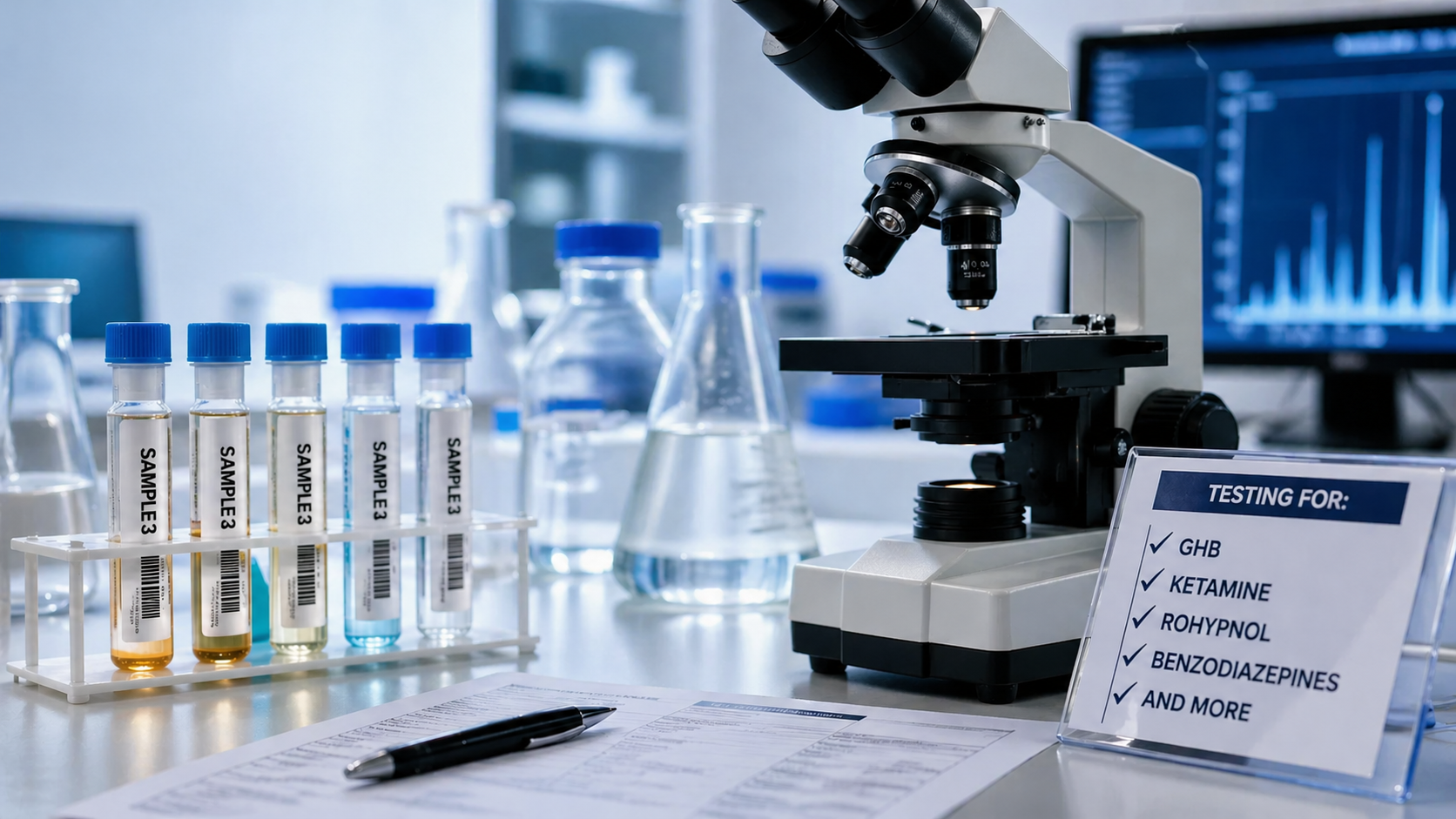
When someone suspects they may have been drugged, one of the most urgent questions is:
“Can this actually be detected?”
The answer is yes—modern forensic laboratories use highly advanced techniques to identify even trace amounts of substances in the body. One of the most important tools is Gas Chromatography–Mass Spectrometry (GC-MS).
This article explains, in simple terms, how testing works, what labs can detect, and why timing matters so you can better understand the science behind it.
Why Detecting Date Rape Drugs is Challenging
Unlike many common substances, drugs used in drink spiking or drug-facilitated assault are often:
- Fast-acting
- Colorless and odorless
- Quickly metabolised by the body
Some substances may leave the bloodstream within hours. Others may remain detectable longer, depending on the type of test used.
That’s why early testing is critical and why laboratories rely on highly sensitive equipment to identify even tiny traces.
What is GC-MS? (Simple Explanation)
Gas Chromatography–Mass Spectrometry (GC-MS) is a laboratory method used to:
- Separate different chemicals in a sample
- Identify each substance based on its molecular structure
Think of it like this:
- Gas Chromatography (GC) separates the ingredients
- Mass Spectrometry (MS) identifies what those ingredients are
Together, they provide a highly accurate “chemical fingerprint” of the sample.
Step-by-Step: How Labs Detect Substances Using GC-MS
1. Sample Collection
Testing begins with collecting biological samples, usually:
- Urine
- Blood
- Hair
Each sample type has a different detection window:
- Blood: Shortest window (hours)
- Urine: Slightly longer (1–3 days depending on substance)
- Hair: Long-term detection (weeks to months)
2. Sample Preparation
Before analysis, the sample is carefully prepared:
- Impurities are removed
- Chemicals are extracted
- The sample is concentrated
This step ensures the test is accurate and reliable, even when substances are present in very small amounts.
3. Gas Chromatography (Separation Phase)
The prepared sample is heated and turned into a gas.
As it moves through the GC system:
- Different substances travel at different speeds
- This separates the mixture into individual components
Each substance exits the system at a specific time, this is called a retention time.
4. Mass Spectrometry (Identification Phase)
Once separated, each substance enters the mass spectrometer.
Here’s what happens:
- Molecules are broken into charged fragments
- These fragments create a unique pattern
- The system compares this pattern to a database
👉 This is how labs identify substances with extremely high precision
5. Results Interpretation
A trained analyst reviews the data to:
- Confirm the presence of substances
- Measure concentration levels
- Rule out false positives
This step is critical because interpretation requires expert knowledge, not just machines
What Substances Can Be Detected?
GC-MS can identify a wide range of substances commonly associated with drink spiking, including:
- GHB (gamma-hydroxybutyrate)
- Rohypnol (flunitrazepam)
- Ketamine
- Benzodiazepines
- Certain sedatives and hypnotics
Even when substances are present in trace amounts, GC-MS can often detect them.
Why Timing Matters So Much
One of the most important factors in testing is when the sample is taken.
Some substances:
- Leave the bloodstream within hours
- Become difficult to detect after 24 hours
This is why people are often advised to seek testing as soon as possible.
However, if time has passed, hair testing may still provide evidence of exposure.
Can Testing Still Work After Time Has Passed?
Yes but it depends on the method used.
Short-Term Testing
- Blood and urine are best for recent exposure
- Most effective within the first 24–72 hours
Long-Term Testing
- Hair testing can detect substances weeks later
- Useful when immediate testing wasn’t possible
This flexibility is one reason why forensic labs use multiple testing approaches.
Accuracy and Reliability of GC-MS
GC-MS is considered the gold standard in forensic toxicology because it offers:
- High sensitivity (detects very small amounts)
- High specificity (reduces false positives)
- Reliable, court-admissible results
However, no test is perfect. Results depend on:
- Sample quality
- Timing
- Proper handling and storage
What Drug Tests Really Reveal
Understanding results is just as important as conducting the test itself.
What Drug Tests Really Reveal is not always straightforward:
- A positive result confirms exposure to a substance
- It does not always indicate when or how it was administered
- It may not explain the full circumstances
This is why results are often used alongside:
- Medical records
- Witness accounts
- Additional forensic evidence
Choosing a Reliable Testing Service
If you are considering testing, it’s important to choose a provider that:
- Offers specialized Gas Chromatography Mass Spectrometry (GC-MS) Testing Services to ensure accurate and reliable forensic analysis
- Follows strict chain-of-custody procedures
- Provides clear, documented results
For example, organisations such as The Carlson Company offer specialised forensic testing services designed to help individuals understand and verify exposure.
When Should You Consider a Date Rape Drug Test?
You may consider a date rape drug test if:
- You experienced sudden dizziness or confusion
- You have memory gaps after a social event
- You felt unusually sedated or disoriented
- You suspect your drink may have been tampered with
Even if you’re unsure, seeking advice early can help preserve potential evidence.
Key Takeaways
- GC-MS is one of the most accurate methods for detecting substances
- Timing plays a critical role in successful detection
- Different sample types provide different detection windows
- Results must be interpreted carefully and in context
- Testing can provide clarity but may not answer every question
Frequently Asked Questions
1. Can labs always detect date rape drugs?
Not always. Detection depends on timing, the type of drug, and the sample used. Some substances leave the body quickly, making early testing important.
2. How long do date rape drugs stay in the body?
It varies. Some drugs may be detectable for only a few hours in blood, while others can be found in urine for a few days or in hair for weeks.
3. Is GC-MS testing accurate?
Yes, GC-MS is considered highly accurate and is widely used in forensic laboratories due to its precision and reliability.
4. Can testing be done after several days?
Yes. While blood and urine may no longer show substances, hair testing can sometimes detect exposure weeks later.
5. Do standard drug tests detect date rape drugs?
Not always. Many standard tests do not include specific substances like GHB, which require specialised testing methods.
