
Quick Answer
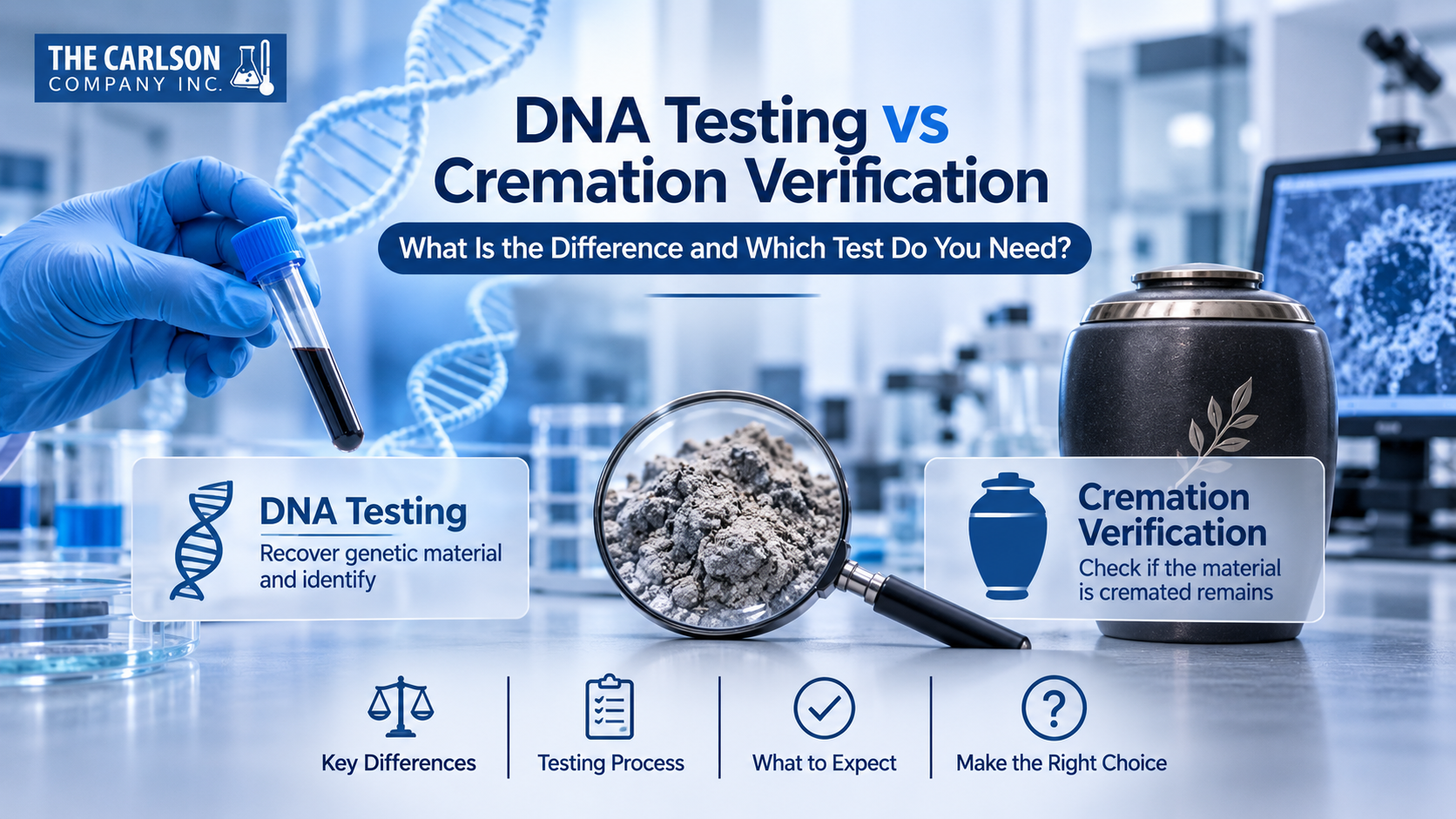
DNA testing and cremation verification are two different laboratory procedures used to investigate cremated remains. DNA testing aims to recover genetic material and establish a biological profile or compare it with a reference sample, whereas cremation verification examines the submitted material to assess whether it contains characteristics consistent with cremated human remains. The appropriate test depends on whether your concern is about a person’s identity, the nature of the material, or both. Neither procedure should be assumed to provide a guaranteed identification.
Introduction
Receiving cremated remains after a loved one’s passing is an emotionally significant experience. Families generally trust that the cremation process has been conducted correctly and that the ashes returned belong to the intended individual. However, questions can sometimes arise about the identity, composition or authenticity of the material.
When these concerns occur, laboratory testing may provide a way to investigate them scientifically. Two terms that frequently cause confusion are DNA testing and cremation verification. Although both involve the examination of cremated remains, they address different questions and rely on different analytical approaches.
Understanding these differences is important before arranging an evaluation. Choosing the appropriate procedure helps establish realistic expectations about what a laboratory can investigate, what information may be obtained and where scientific limitations exist.
1. What Is DNA Testing of Cremated Remains?
DNA testing is a laboratory procedure that examines genetic material to develop a DNA profile or investigate a possible biological relationship.
In cases involving cremated remains, the process can be particularly challenging because the high temperatures associated with cremation cause extensive damage to biological material. Most soft tissue and much of the recoverable DNA are destroyed.
However, research indicates that some genetic material may occasionally survive in protected or incompletely burned skeletal material, including certain bone fragments and teeth.
A laboratory may assess whether the submitted material contains recoverable DNA and whether it is suitable for further analysis.
What Can DNA Testing Establish?
Depending on the quality and quantity of recovered genetic material, DNA analysis may help:
- Develop a genetic profile from suitable biological material.
- Compare recovered DNA with an appropriate reference sample.
- Investigate whether two samples may share a biological relationship.
- Support an identification investigation when sufficient comparative information is available.
It is important to distinguish between recovering DNA and confirming someone’s identity. A laboratory may obtain a partial genetic profile without having enough information to establish whose remains were submitted.
For further information about the scientific challenges involved, read about DNA testing of cremated remains.
2. What Is Cremation Verification?
Cremation verification is a laboratory evaluation intended to investigate the composition and characteristics of submitted cremated material.
Unlike DNA testing, its primary objective is not to establish an individual’s genetic identity. Instead, the examination focuses on whether the submitted material contains characteristics consistent with cremated biological or human remains.
This distinction matters when someone has concerns about what is actually contained in an urn or whether the material returned after cremation is consistent with the expected remains.
A laboratory may examine the available sample using suitable analytical methods to assess its composition and identify relevant findings.
What Can Cremation Verification Help Investigate?
Depending on the testing method and the condition of the submitted material, an evaluation may help investigate:
- Whether the material contains characteristics consistent with cremated remains.
- Whether the sample shows evidence of biological material.
- Whether its composition raises questions requiring further laboratory examination.
- Whether additional testing may be appropriate to investigate a particular concern.
However, verification should not automatically be interpreted as proof of an individual’s identity. Establishing that material is consistent with human cremains and establishing whose remains they are are two separate scientific questions.
3. DNA Testing vs Cremation Verification: Key Differences
Although both procedures can involve cremated material, their objectives, analytical requirements and potential findings differ.
| Comparison | DNA Testing | Cremation Verification |
| Primary purpose | Investigate genetic material and biological identity | Examine the characteristics and composition of cremated material |
| Main focus | DNA recovery and genetic profiling | Material composition and laboratory findings |
| Key question | Can a usable DNA profile be obtained? | Is the material consistent with cremated remains? |
| Reference samples | May be needed for comparative identification | Not necessarily required for a material-composition evaluation |
| Main limitation | DNA may be destroyed or too degraded to analyse | Findings may not establish an individual’s identity |
| Potential outcome | DNA profile, partial profile or inconclusive result | Laboratory findings about the submitted material |
The most important difference is the question each test is designed to answer. DNA analysis investigates genetic information, while cremation verification investigates the submitted material itself.
One procedure does not automatically replace the other. In certain circumstances, both may be considered if the concerns involve different aspects of the same sample.
4. Why Can DNA Testing of Cremated Remains Be Difficult?
Cremation exposes remains to intense heat, which can break down DNA molecules and alter the structure of biological tissues.
Even when some skeletal material survives, recovering a usable genetic profile is not straightforward.
Several factors can influence the outcome:
Temperature and duration of exposure: Greater thermal exposure generally increases DNA damage. The extent of degradation depends on the conditions experienced by the material.
Type of material: Dense skeletal structures may offer a better possibility of retaining genetic material than finely processed ash. However, no particular fragment guarantees successful DNA recovery.
Sample condition: Moisture, environmental exposure, contamination and handling can affect the suitability of material submitted for analysis.
DNA degradation: Genetic material may survive only in short or damaged fragments, making it difficult to develop a complete profile.
Research published in Forensic Science International: Synergy in 2025 examined the relationship between thermal exposure, bone characteristics and DNA recovery. The study demonstrated that DNA recovery varied with heat exposure and changes in bone structure. Its findings also reinforce why individual samples require careful assessment rather than assumptions based on appearance alone.
These limitations explain why DNA testing of cremated remains cannot carry the same expectations as testing a conventional biological sample.
5. Which Test Should You Choose?
The right approach depends on what you are trying to establish. Before submitting material, consider the nature of your concern.
Choose DNA Testing If Your Main Concern Is Identity
If you want to investigate whether genetic material can be recovered from cremated remains or compare it with a known reference sample, DNA analysis may be appropriate.
For example, a family may have questions about whether the remains correspond to a particular individual. In such circumstances, DNA analysis may provide useful information if sufficient genetic material survives.
However, an appropriate reference sample may be necessary to support identification. This could include previously collected biological material belonging to the individual or suitable samples from biological relatives, depending on the investigation.
Choose Cremation Verification If Your Main Concern Is Material Authenticity
If your concern relates to the actual composition of the material inside an urn, cremation verification may be more relevant.
For instance, you may wish to investigate whether the submitted material contains characteristics consistent with cremated human remains.
This type of evaluation focuses on the material rather than attempting to establish a genetic identity.
Consider Both If You Have Multiple Concerns
Some situations involve more than one question. You may want to investigate both the composition of cremated material and whether recoverable DNA is present.
In these circumstances, discussing the available testing options with a laboratory before submission is advisable. The laboratory can explain which procedures may address your concerns and whether the sample is suitable for the requested evaluation.
6. What Should You Consider Before Submitting Cremated Remains for Testing?
Before arranging any laboratory evaluation, it is worth considering the following points:
- Explore alternative samples first. If your objective is DNA identification, previously collected blood, tissue, biopsy material or other biological samples may offer a more suitable starting point. Hospital, hospice, autopsy or medical examiner records may help identify whether such material exists.
- Explain your specific concern. Be clear about whether you want to investigate identity, material composition or possible chemical substances. Different objectives may require different analytical procedures.
- Preserve the sample carefully. Avoid unnecessary handling, mixing or transferring of cremated material. Follow the laboratory’s instructions regarding collection, packaging and submission.
- Ask about testing limitations. Understand the possibility of partial findings, inconclusive results or unsuccessful DNA recovery before proceeding.
- Understand sample documentation. A chain of custody records the handling and transfer of a submitted sample. Proper documentation can help maintain traceability throughout the testing process.
The laboratory testing policies and procedures provide further information about sample submission, documentation and testing expectations.
7. Why Laboratory Expertise and Scientific Interpretation Matter
Testing cremated remains requires more than simply selecting an analytical procedure. The sample’s condition, the question being investigated and the limitations of the available method all influence how findings should be interpreted.
A responsible laboratory assessment should explain what was examined, which findings were obtained and what those findings can reasonably establish.
It should also distinguish between a positive detection, an inconclusive result and the absence of a detectable finding. These outcomes are not interchangeable.
For example, failure to recover DNA does not establish that the material is not human. Similarly, finding characteristics consistent with cremated remains does not establish the identity of the deceased.
The Carlson Company provides laboratory testing services involving cremated remains, DNA analysis and forensic toxicology. Its laboratory services cover different testing requirements, allowing individuals to discuss the appropriate analytical direction before proceeding.
Scientific neutrality is particularly important in sensitive cases. Laboratory conclusions should be based on the submitted sample and the findings obtained, rather than assumptions about what a person expects the results to show.
Frequently Asked Questions
1. Can you tell someone’s DNA from their ashes?
Sometimes. Although cremation destroys most recoverable DNA through intense heat, small amounts of genetic material may occasionally survive in certain bone fragments or other protected skeletal material. A laboratory must first establish whether recoverable DNA is present. If a suitable profile is obtained, comparison with an appropriate reference sample may help investigate identity. Successful identification is not guaranteed.
2. How long do human ashes last in an urn?
Cremated remains are largely composed of mineralised bone material and do not decompose in the same way as soft biological tissue. When kept in a suitable, dry and secure urn, they can remain preserved for many decades or longer. The condition of the container and exposure to moisture or environmental damage can affect their physical preservation.
3. Why are you not supposed to keep ashes in your house?
There is no universal scientific rule that prohibits keeping cremated remains at home. Some cultural, religious and personal beliefs influence how families choose to store or memorialise ashes. From a practical perspective, keeping them in a secure, dry and respectful location is generally sensible. Families should make this decision according to their beliefs, preferences and local requirements.
4. What is the dark side of cremation?
Concerns sometimes associated with cremation include uncertainty about the identification and handling of remains, environmental considerations, and the difficulty of investigating certain biological or toxicological questions after the process. Cremation also makes conventional DNA recovery significantly more challenging. These concerns do not mean that cremation is inherently unsafe or improperly conducted; they highlight why appropriate procedures, documentation and professional oversight matter.
5. Can cremation ashes be tested to confirm whether they are human?
Yes, laboratory evaluation may help examine whether submitted material contains characteristics consistent with human cremated remains. The findings depend on the sample’s composition, condition and analytical method. However, determining that material is consistent with human cremains is different from identifying the individual it came from. A laboratory should explain the scope and limitations of the particular evaluation.
Conclusion: Choose the Right Testing Approach for Your Concerns
DNA testing and cremation verification serve different purposes, and understanding their distinction is essential before arranging an evaluation. DNA analysis focuses on genetic material and possible identification, while cremation verification examines the composition and characteristics of the submitted remains.
The most suitable option depends on the questions you want answered, the condition of the sample and the scientific possibilities available. In some cases, alternative biological samples may provide a more practical route to investigation.
If you have questions about cremated remains testing or need help determining which laboratory evaluation may be appropriate, contact The Carlson Company for guidance.
Contact us now or call +1 866-889-3410 to discuss your testing requirements, available sample options and the next steps for a laboratory evaluation.
