
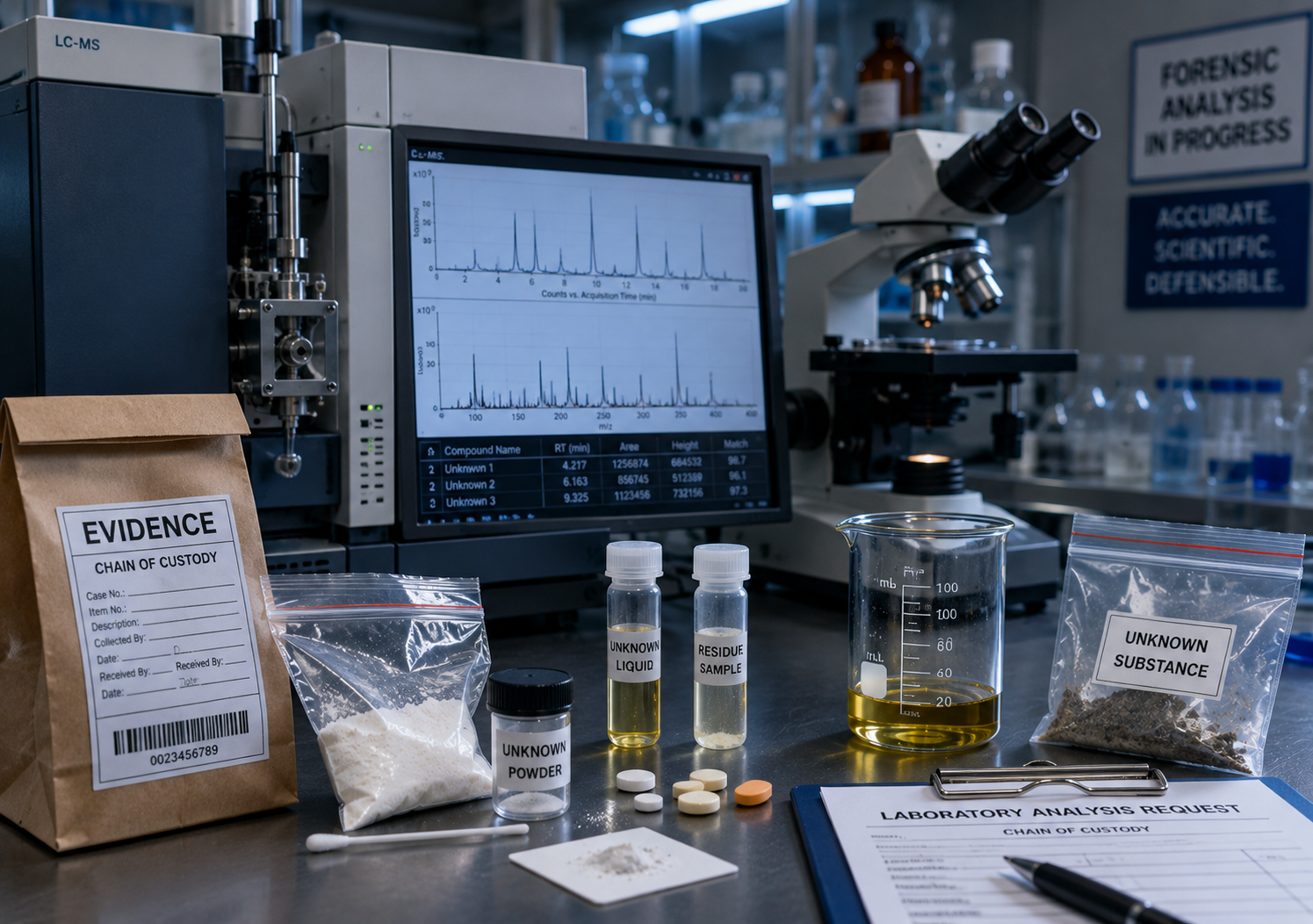
Uncertainty around an unknown substance can quickly become a matter of safety, health, or legal urgency. Whether it is an unidentified pill, a suspicious powder, a liquid with an unusual odor, or a residue found on personal belongings, assumptions are not enough.
At The Carlson Company, we provide scientific clarity. Using validated forensic methods, our analysts identify unknown substances with accuracy and document findings in formats suitable for medical, legal, and investigative use, serving clients across the United States.
About This Article
This guide explains the most common real-world situations that lead individuals, attorneys, employers, and law enforcement professionals to request unknown substance testing and how Carlson’s laboratory process works from sample submission to final report.
Why People Seek Unknown Substance Testing
Most clients do not initially frame their need as ‘substance testing.’ They begin with a situation that feels uncertain or alarming. The scenarios below represent the most frequent reasons people contact Carlson for laboratory analysis.
1. Finding an Unknown Pill or Capsule
One of the most common reasons individuals contact us is discovering a pill that cannot be identified by sight alone.
This typically arises when:
- A medication is found without its original packaging
- A pill does not match a prescription label or expected appearance
- There is concern that a medication has been counterfeited or substituted
Carlson’s pill testing service uses high-performance liquid chromatography (HPLC) and liquid chromatography-mass spectrometry (LC-MS) to determine whether a tablet or capsule matches a known pharmaceutical formulation or contains unexpected compounds.
Who contacts us for this: Individuals, caregivers, pharmacists, attorneys handling medication liability cases, and employers investigating workplace incidents.
2. Suspicious Powder or Residue Discovery
When an unidentified powder or residue appears unexpectedly in a home, workplace, or vehicle, uncertainty can escalate quickly, particularly when safety, legal liability, or possible exposure is involved. Clients typically want to know: what is it, is it harmful, and could it represent a chemical exposure risk?
Carlson analyzes these samples using:
- Fourier Transform Infrared Spectroscopy (FTIR) for rapid compound class identification
- Gas Chromatography-Mass Spectrometry (GC-MS) for volatile and semi-volatile compound detection
- LC-MS for non-volatile organic compounds
Results are cross-verified using multiple methods and compared against certified chemical reference libraries, reducing the risk of false identification.
Who contacts us for this: Individuals, law enforcement agencies, insurance adjusters, and attorneys requiring documented forensic evidence.
3. Suspected Contamination in Food or Drink
Testing is frequently requested when food or beverages appear to have been altered or contaminated. This concern may arise when taste or smell is unusual, when unexplained illness follows consumption, or when there is reason to suspect external interference.
Laboratory analysis in these cases focuses on detecting toxins, drug compounds, or chemical anomalies not consistent with the product’s expected formulation. Carlson’s confirmatory testing approach uses GC-MS, LC-MS, and ion chromatography to establish whether chemical deviation is present.
Disclaimer
Carlson provides chemical analysis and laboratory interpretation. Results are intended to support medical consultation, legal proceedings, or investigative review, not to serve as a standalone diagnosis or legal conclusion. Findings should be evaluated with appropriate professional guidance.
Who contacts us for this: Individuals, families, medical professionals supporting a clinical evaluation, and attorneys handling personal injury or product liability cases.
4. Legal, Workplace, and Investigative Referrals
A significant portion of Carlson’s caseload comes from structured professional referrals. In these situations, the goal is not only identification but also the production of documentation that meets evidentiary and compliance standards.
Common referral types include:
- Attorney-requested analysis for civil or criminal litigation
- Employer-directed testing in workplace safety investigations
- Law enforcement submissions requiring independent laboratory confirmation
- Insurance and liability-related forensic documentation
Carlson issues structured laboratory reports that document chain of custody, analytical methods used, findings, and interpretive conclusions, suitable for court submission or regulatory review.
Who contacts us for this: Attorneys, law enforcement agencies, HR departments, risk managers, and compliance officers.
5. Toxicology Screening After Possible Exposure
Individuals sometimes seek analysis after potential exposure to an unknown substance, particularly when symptoms are unexplained or when a clinical team requires additional chemical information.
Carlson’s toxicology screening panels detect drugs, toxins, and chemical agents using validated forensic methods. Results are provided in structured report formats that can be shared directly with medical providers or legal counsel.
Who contacts us for this: Individuals, physicians, emergency response teams, and attorneys supporting medical malpractice or personal injury cases.
6. DNA Testing for Identity or Relationship Verification
In addition to substance analysis, Carlson offers forensic DNA testing for cases requiring biological identification. This includes parentage verification, relationship testing, and forensic sample analysis submitted through legal or investigative channels.
DNA results are produced using validated STR (Short Tandem Repeat) analysis and are reportable in formats accepted by courts and government agencies across the United States.
Who contacts us for this: Individuals, immigration attorneys, family law firms, and law enforcement agencies.
How Carlson Conducts Unknown Substance Testing
Carlson does not rely on single-test screening. Every sample undergoes a multi-method analytical workflow designed to maximize accuracy and minimize the risk of false identification.
Our standard process includes:
- Sample intake and chain-of-custody documentation
- Initial screening to determine compound class and guide method selection
- Instrumental analysis using two or more validated techniques
- Cross-verification of findings against certified chemical reference libraries
- Interpretation and reporting by trained forensic analysts
Analytical methods available at Carlson include:
- Gas Chromatography-Mass Spectrometry (GC-MS)
- Liquid Chromatography-Mass Spectrometry (LC-MS)
- Fourier Transform Infrared Spectroscopy (FTIR)
- High-Performance Liquid Chromatography (HPLC-DAD)
- Ion Chromatography
- STR-based DNA Analysis
Forensic Laboratory Case Studies
Case Study 1: Suspected Contamination in a Beverage
A client submitted a beverage sample following unexplained illness after consumption.
Testing performed: GC-MS, LC-MS, HPLC-DAD, Ion Chromatography
Findings: GC-MS detected no common drug compounds. LC-MS identified a non-volatile compound inconsistent with the beverage’s expected chemical profile. HPLC revealed additional peaks relative to the reference control. Ion analysis indicated abnormal composition.
Interpretation: Results indicated chemical deviation from expected formulation, supporting further investigative review. Report was issued in attorney-ready format for civil proceedings.
Case Study 2: Unknown Residue on Personal Belongings
An unknown residue was discovered on a client’s personal items and submitted for forensic identification.
Testing performed: FTIR, GC-MS, LC-MS
Findings: FTIR identified a complex mixture of chemical compounds. GC-MS detected trace hydrocarbon and solvent-related substances. LC-MS confirmed additional non-volatile organic components.
Interpretation: The residue showed characteristics consistent with externally introduced chemical material. Chain-of-custody documentation was maintained throughout for potential legal use.
Case Study 3: Suspected Drug Tampering in Medication
A medication sample was submitted by an attorney following client concern that the formulation had been altered.
Testing performed: HPLC, LC-MS, GC-MS
Findings: HPLC revealed unexpected chemical peaks. LC-MS detected compounds inconsistent with the labeled pharmaceutical formulation. GC-MS confirmed deviation from the expected drug profile.
Interpretation: Results indicated chemical inconsistency with the original formulation, supporting the attorney’s inquiry into possible tampering. Findings were documented in court-admissible format.
When to Contact Carlson for Testing
You may benefit from Carlson’s laboratory services when:
- A substance cannot be reliably identified by appearance alone
- There is concern about safety, toxicity, or possible contamination
- Medication, food, or a drink appears to have been altered
- Legal or investigative documentation of chemical findings is required
- Exposure has occurred and medical evaluation needs supporting data
- DNA-based identification or relationship testing is needed
Carlson serves individuals, legal professionals, employers, and law enforcement agencies throughout the United States. Sample submission instructions and chain-of-custody forms are available on our website.
Final Thoughts
Unknown substance testing replaces uncertainty with scientific clarity. Instead of assumptions, laboratory analysis provides structured identification using validated forensic methods and documentation that can support whatever comes next, whether that is a medical consultation, a legal proceeding, or a safety decision.
At The Carlson Company, that process is handled with the precision and discretion the situation demands.
Frequently Asked Questions
When Should You Consider Unknown Substance Testing?
Unknown substance testing may be appropriate when a pill, powder, liquid, or residue cannot be confidently identified and there are concerns about safety, contamination, toxicity, or legal documentation.
Can Appearance Alone Reliably Identify a Substance?
No. Many substances look similar visually, including medications, powders, and chemical compounds. Laboratory analysis is often necessary to determine the actual composition of a material.
Why Do Attorneys Request Forensic Substance Analysis?
Attorneys may request laboratory testing to obtain scientifically documented findings for litigation, liability disputes, workplace investigations, contamination claims, or evidentiary review.
What Makes Forensic Laboratory Testing Different From Basic Drug Screening?
Forensic laboratory testing uses validated analytical instruments, multi-method confirmation, reference library comparison, and documented chain-of-custody procedures rather than relying on preliminary screening alone.
Can Testing Help Investigate Possible Medication Tampering?
Yes. Laboratory analysis may identify chemical inconsistencies, unexpected compounds, or deviations from expected pharmaceutical formulations when medication tampering is suspected.
Why Is Multi-Method Verification Important in Unknown Substance Testing?
Using multiple analytical methods helps improve accuracy, reduce false identification risk, and strengthen confidence in the final laboratory findings.
What Information Is Included in a Forensic Laboratory Report?
A forensic laboratory report may include:
- analytical methods used,
- chain-of-custody documentation,
- identified compounds,
- interpretive findings,
- and supporting forensic observations relevant to the investigation.
Who Typically Uses Unknown Substance Testing Services?
These services are commonly used by individuals, attorneys, employers, investigators, medical professionals, insurance representatives, and law enforcement agencies seeking scientifically documented analysis.
Ready to Submit a Sample for Analysis?
The Carlson Company provides court-admissible unknown substance testing across the United States. Whether you are an individual, attorney, employer, or law enforcement professional our analysts are ready to help.
