
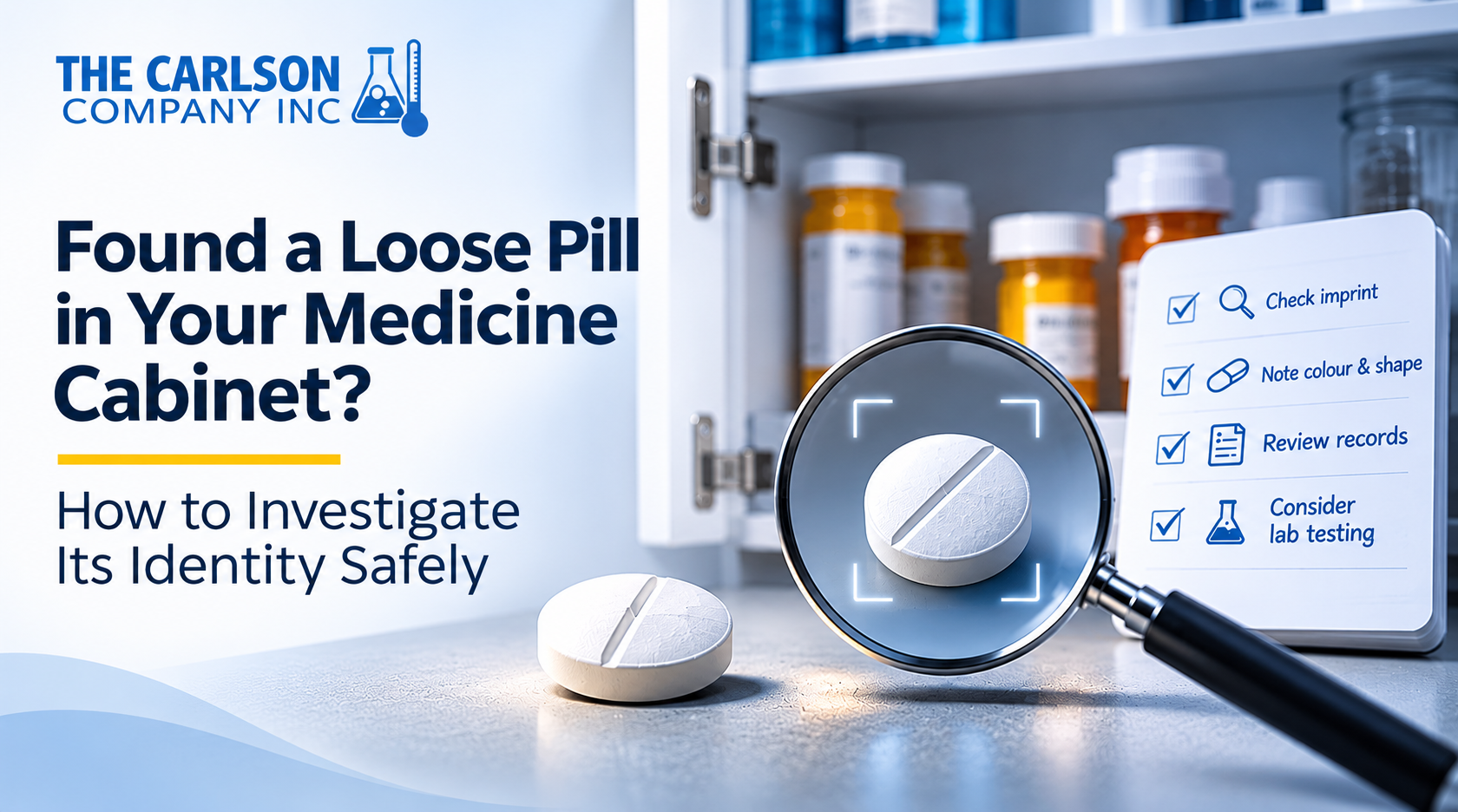
Quick Answer:
If you find a loose pill in your medicine cabinet, do not take it or give it to anyone. Keep it away from children and pets, examine its visible markings without unnecessarily handling it, and check whether the original prescription packaging or medication records can help establish its identity. Record its imprint, colour, shape and size, then consult a pharmacist or a reliable pill identification resource. If its identity remains uncertain, professional laboratory testing may help determine its chemical composition. Never assume a visual match confirms what a pill contains.
Introduction
Medicine cabinets often accumulate medications over time. Prescriptions change, old treatments remain unused, and individual tablets can become separated from their original packaging. Eventually, you may discover a tablet or capsule that nobody in the household recognises.
Although identifying an unfamiliar pill might appear straightforward, its appearance alone cannot establish its identity. Different medications can share similar physical characteristics, while the same medication may look different depending on its manufacturer.
An unidentified tablet also raises questions about its storage, condition and possible contamination. Understanding how to investigate these situations carefully can help prevent accidental medication errors and unnecessary exposure.
This article explains how to approach an unfamiliar pill, which identification methods can help, when professional assistance is necessary, and why laboratory analysis may be important when visual identification is inconclusive.
1. Secure the Pill Before Attempting Identification
Your first priority should be preventing accidental exposure rather than determining the medication immediately.
A loose tablet can easily be mistaken for a familiar prescription, particularly in households where multiple people use different medications. Children and pets may also pick up unattended tablets.
Follow these precautions:
- Keep the unidentified pill away from children, pets and anyone who might accidentally swallow it.
- Avoid placing it alongside other medications.
- Do not taste, crush, break or dissolve it to investigate its contents.
- Avoid unnecessary direct contact and wash your hands after handling it.
- Keep it separate from food, drinks and household products.
If you suspect someone has swallowed the pill, seek immediate medical or poison-control advice. Do not wait for symptoms to appear. In the United States, Poison Help is available at 1-800-222-1222. Call 911 for a medical emergency.
2. Record the Pill’s Physical Characteristics
Once the sample is secure, document its visible characteristics. These details can help narrow down possible matches through a recognised pill identification resource.
Pill imprint: Look for letters, numbers, logos or other markings on both sides. Record the characters exactly as they appear. Even one incorrect letter or number can produce a misleading identification result.
Colour: Note the primary colour and whether the pill has multiple colours, a coating or visible discolouration.
Shape: Identify whether it is round, oval, oblong, capsule-shaped or another distinctive form.
Size: Estimate its dimensions if this can be done safely without damaging the sample. Size can help distinguish between otherwise similar-looking medications.
Additional markings: Record scoring lines, unusual patterns, surface coatings or visible damage.
These characteristics are useful for preliminary identification, but none independently confirms the medication’s chemical composition.
For a more detailed explanation of these identification features, consult The Carlson Company’s drug pill identifier and pill finder resource.
3. Check Prescription Records and Reliable Identification Resources
Before assuming that the pill is unfamiliar, consider whether it could belong to an existing or previous prescription.
Check medication records, pharmacy receipts, prescription labels and previous packaging. If another household member recognises the medication, ask them to verify it against their prescription records rather than relying on memory.
You can also use an established pill identification database to investigate possible matches.
These tools typically allow users to search using:
- Letters or numbers printed on the tablet.
- Pill colour and physical shape.
- Approximate size and other visible characteristics.
- Known medication names or ingredients.
However, database results should be treated as potential matches, not proof. A database may not contain every formulation, manufacturer, foreign-market medication or non-standard pharmaceutical product.
4. Understand Why Some Pills Cannot Be Identified Visually
Not every unidentified tablet will produce a reliable result through an online search.
Several circumstances can make identification difficult.
Missing or damaged imprints: Some tablets have no visible markings, while others may have worn or damaged imprints that make character recognition difficult.
Similar physical appearances: Different medications can share comparable colours, shapes and sizes. A visual match may therefore produce multiple possible results.
Generic medication variations: Generic medications may differ in colour, shape, coating and markings even when they contain the same active ingredient as a brand-name product.
Counterfeit or altered products: A counterfeit tablet may imitate the appearance of a legitimate medication without containing the expected ingredients.
Unknown origin: Pills obtained outside standard pharmaceutical supply channels may not appear in conventional medication databases.
These limitations explain why identifying a pill by appearance is different from confirming what substances it actually contains.
If you cannot establish a reliable identity, do not take the medication or attempt to verify it through taste, smell or home experiments.
5. When Should You Consider Professional Laboratory Testing?
When visual identification and prescription records cannot establish what a pill is, professional chemical analysis may provide additional information.
Laboratory testing is particularly relevant when an unknown tablet may contain an unexpected substance, has potentially been altered, or requires investigation beyond a preliminary identification.
Unlike a visual identification database, laboratory analysis examines the sample itself. Depending on the material and testing objective, appropriate analytical methods can help identify detectable chemical compounds or investigate the presence of specific substances.
For example, GC-MS (Gas Chromatography-Mass Spectrometry) is an analytical technique used in chemical investigations to separate and identify compounds within suitable samples.
Professional unknown drug testing may be useful in situations involving:
- Unidentified tablets or capsules discovered at home.
- Suspected counterfeit or altered medications.
- Pills that do not produce reliable database matches.
- Samples requiring investigation for specific pharmaceutical compounds.
- Unknown substances associated with workplace, medical or forensic investigations.
The appropriate analytical method depends on the sample, the suspected compounds and the question the investigation needs to answer. Not every testing method detects every possible substance, so the laboratory should establish the testing requirements before analysis.
6. How to Prepare an Unknown Pill for Professional Analysis
If laboratory testing is being considered, documenting the sample properly can help the laboratory understand the investigation.
Photograph the sample: Take clear photographs of both sides, showing visible markings, colour, shape and any damage.
Record the circumstances: Note where the pill was discovered, whether it was loose or inside packaging, and any relevant background information.
Preserve the sample: Keep it separate from other substances and avoid unnecessary handling or alteration.
Explain the testing objective: Clarify whether you need to investigate an unknown medication, determine the presence of a particular compound or examine a potentially altered sample.
Ask about submission requirements: Packaging, sample quantity and documentation depend on the material and the testing requested. Contact the laboratory before shipping anything potentially hazardous.
For legal or forensic investigations, maintaining proper documentation and a documented chain of custody is especially important. This helps establish how evidence was collected, transferred and handled throughout the investigation.
7. Prevent Loose Pills from Accumulating in Your Medicine Cabinet
The best way to avoid future identification problems is to improve medication storage and organisation.
Consider these practical measures:
- Store medications in their original labelled containers whenever possible.
- Keep different household members’ prescriptions separate.
- Check medication packaging before taking any tablet.
- Dispose of expired or unwanted medications through appropriate take-back programmes.
- Avoid combining unidentified tablets with recognised prescriptions.
- Review your medicine cabinet periodically and remove medications that are no longer needed.
If a medication looks different from your usual prescription, contact your pharmacist before taking it. Manufacturers and formulations can change, but an unexpected appearance should always be verified through an appropriate source.
Conclusion: Don’t Guess When a Pill’s Identity Is Uncertain
Finding a loose pill in your medicine cabinet does not necessarily mean something is wrong, but it should never be treated as an opportunity to guess. Recording its physical characteristics, checking prescription records and consulting reliable identification resources can help narrow down possible matches. However, visual identification cannot confirm the actual chemical contents of an unknown tablet.
When an unidentified pill requires further investigation, professional laboratory analysis can provide information that appearance-based identification cannot establish.
The Carlson Company provides professional unknown drug testing and chemical analysis to help investigate unidentified substances. Whether you have discovered an unfamiliar tablet or need to determine which compounds may be present in a sample, the appropriate testing approach depends on your specific requirements.
Contact us now to discuss your sample, understand the available testing options and determine the appropriate next steps for your investigation.
Contact The Carlson Company to discuss your testing requirements.
Frequently Asked Questions (FAQs)
1. How can I identify a pill I found in my medicine cabinet?
Start by recording its imprint, colour, shape and approximate size. Check prescription records and use a reliable pill identification database to investigate potential matches. Consult a pharmacist if you remain uncertain. An online match does not confirm the pill’s chemical contents.
2. Can I identify a pill by its colour and shape alone?
No. Colour and shape can help narrow down possible medications, but different drugs may share similar physical characteristics. Imprints, size and other markings provide additional information. Even when all visible features match, laboratory analysis may be necessary to investigate the actual chemical composition.
3. What should I do if I find a pill with no markings?
Do not take it or give it to anyone. Keep it securely away from children and pets, check whether its original packaging is available, and consult a pharmacist or poison-control professional. If its identity remains unknown, professional laboratory analysis may help investigate its composition.
4. Can a laboratory identify an unknown pill?
Yes. A laboratory can analyse an unknown pill to identify detectable chemical compounds, depending on the sample and analytical method used. Techniques such as GC-MS may be appropriate for certain substances. The laboratory should determine the suitable testing approach based on the investigation’s objectives.
5. Is it safe to take a pill if it looks identical to my prescription medication?
No. Physical resemblance does not establish that a tablet contains the expected medication, has been stored correctly or is safe to consume. Never take an unidentified pill, even if it looks identical to a familiar prescription. Verify medication through a pharmacist or appropriate medical professional.
